



A Complete Technical Guide from Powder to Finished Metal Parts
By hqt
06, 2026
Related Posts
MIM Materials Explained: Composition, Classification, and Engineering Applications
Jul 02, 2026
A Complete Technical Guide from Powder to Finished Metal Parts
Jun 01, 2026
Global Metal Injection Molding (MIM) Industry Trends in 2026: Growth Driven by Precision Manufacturing Demand
Jun 01, 2026
A Leading MIM Manufacturer Providing Full-Process Precision Metal Solutions
May 30, 2026
Meta Description
A detailed guide explaining the full MIM process, including materials, steps, engineering principles, and design considerations.
Introduction
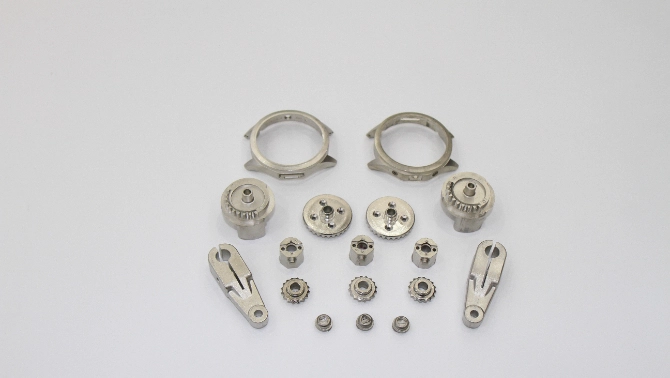
Metal Injection Molding (MIM) is an advanced manufacturing process that combines powder metallurgy and plastic injection molding technology. It enables the production of complex, high-precision metal components at large scale with excellent material efficiency and mechanical performance.
1. What is Metal Injection Molding (MIM)?
MIM is a hybrid manufacturing process that transforms fine metal powders into solid, functional metal parts through injection molding and sintering.
It is ideal for:
- Small and complex components
- High-volume production
- Tight tolerance requirements
2. Step-by-Step MIM Process
The MIM process consists of five main stages:
1) Feedstock Preparation
Metal powders (5–20μm) are mixed with binders to form a uniform feedstock.
2) Injection Molding
The feedstock is injected into precision molds under high pressure to form green parts.
3) Debinding
Binders are removed through thermal or solvent processes.
4) Sintering
Parts are heated to high temperatures (1230–1385°C) to achieve densification.
5) Post-Processing
CNC machining, polishing, and surface treatment are applied if required.
3. Key Materials Used in MIM
Common materials include:
- Stainless steel 304 / 316L
- 17-4PH precipitation hardened steel
- 420 / 440C martensitic steel
- Low alloy steels
- Titanium alloys (TC4)
4. Engineering Challenges in MIM
Key technical challenges include:
- Shrinkage control (15%–20%)
- Density consistency (96%–99.5%)
- Deformation during sintering
- Mold flow balance
Proper design and process control are essential for success.
5. Design Guidelines (DFM for MIM)
Important design considerations:
- Uniform wall thickness
- Proper draft angles
- Avoid sharp corners
- Optimize gating system
- Account for shrinkage compensation
Good design significantly reduces defect rates and cost.
6. Advantages of MIM Technology
- High design flexibility
- Complex geometry capability
- High material efficiency (>95%)
- Suitable for mass production
- Comparable performance to forged parts
Conclusion
MIM technology is a highly efficient manufacturing solution for producing complex metal components with excellent precision, consistency, and scalability.


Contact Us
In This Article
Related Posts
MIM Materials Explained: Composition, Classification, and Engineering Applications
Jul 02, 2026
A Complete Technical Guide from Powder to Finished Metal Parts
Jun 01, 2026
Global Metal Injection Molding (MIM) Industry Trends in 2026: Growth Driven by Precision Manufacturing Demand
Jun 01, 2026
A Leading MIM Manufacturer Providing Full-Process Precision Metal Solutions
May 30, 2026